
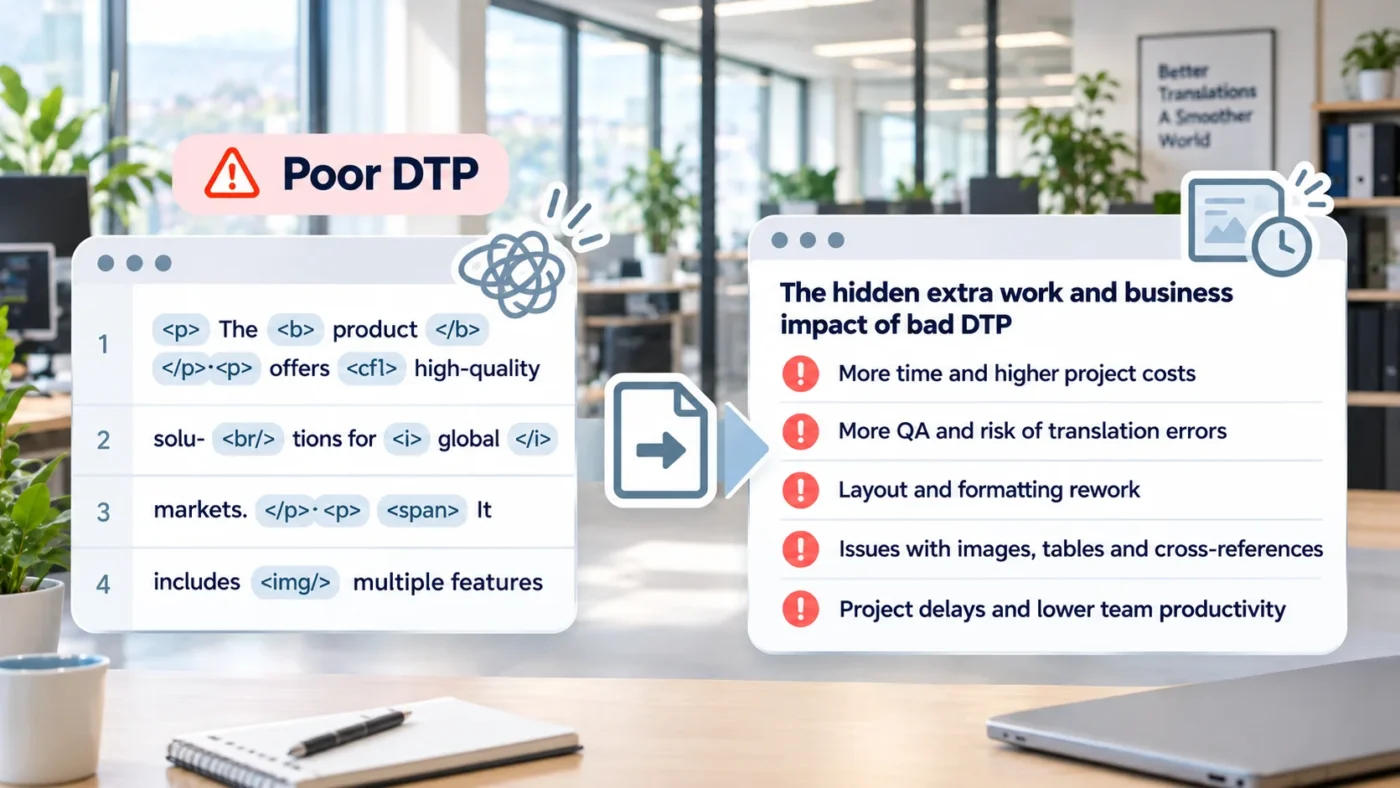
After more than 20 years of full-time work in the translation industry, one problem has stood out for its ability to derail an otherwise straightforward project: a badly prepared source file.
For translation agencies handling high-volume projects, poor DTP introduces costly delays that are easy to underestimate. The words may be correct. The document may even look reasonably close to the original. Yet the moment a linguist opens it in a CAT tool, the underlying structure turns an ordinary assignment into an obstacle course.
And the person who often pays for that poor preparation is the linguist.
Poor DTP in translation: what it looks like inside a CAT tool
A scanned PDF is processed through OCR to create an editable Word document, then imported into a CAT tool. The result appears editable, so the job is assigned. But a file that looks editable is not necessarily translation-ready.
Poor source-file structure can disrupt CAT tool segmentation. A single sentence may arrive as several disconnected segments, even when those fragments belong together grammatically. The translator has to keep the entire sentence in mind while working through pieces that may not be mergeable within the project’s file structure or settings.
Inline tags can also appear between ordinary words. Some protect meaningful formatting and must be preserved; others are artifacts of the conversion process, such as tiny changes in fonts, spacing, character styling or paragraph construction that should never have been introduced.
To make matters worse, translation agency project managers often instruct linguists to preserve every inline tag. That requirement makes sense for tags carrying essential formatting, but it becomes a serious burden when poor source-file preparation generates dozens of unnecessary tags. Translators cannot simply remove them. They must translate accurately while keeping track of tags that should have been eliminated before the file reached the CAT tool.
Missing or misplaced tags can then trigger QA warnings and additional corrections. The translator spends valuable time managing formatting problems created upstream instead of concentrating on the translation itself.
Bad DTP versus clean DTP: the same source in Trados
The screenshots compare the same Spanish source in Trados Studio before and after proper DTP preparation.
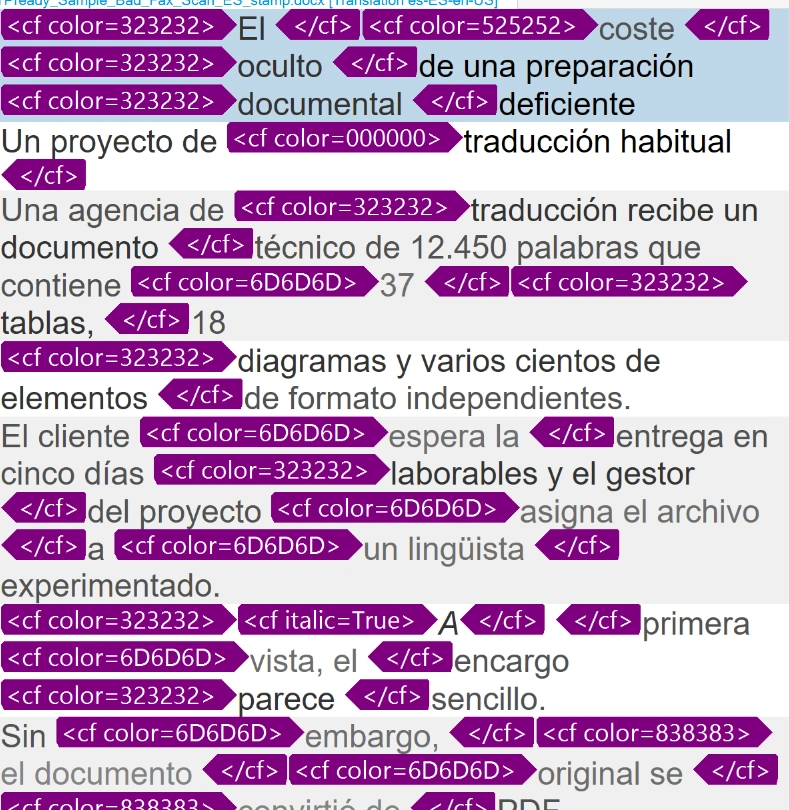
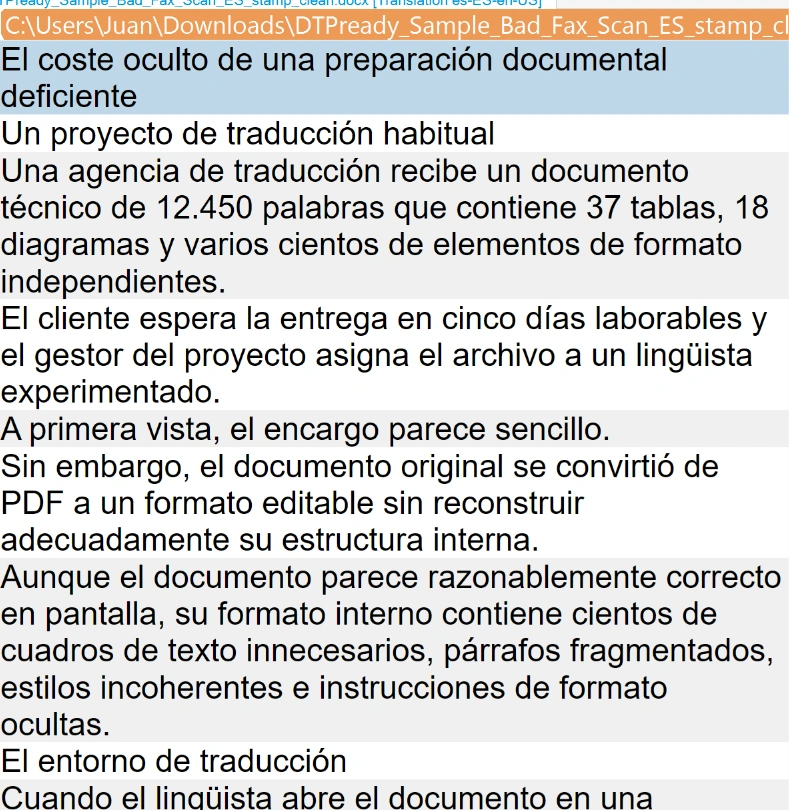
The difference is more than visual. Unnecessary formatting tags interrupt the translation process, waste time and increase the risk of errors.
When one sentence becomes multiple CAT tool segments
Consider a technical instruction that is logically one sentence. In a clean source file, a CAT tool can usually present it as a coherent unit, subject to the project’s segmentation rules. In a poorly constructed file, manual line breaks, text frames or other structural boundaries can divide that instruction into multiple fragments.
Where segments cannot be merged, the linguist is forced to translate across artificial boundaries. Terminology, agreement, syntax and meaning still have to work as a whole. But the editor presents them as disconnected tasks.
This is especially damaging when translating between languages with different word order. A translator may need to reorganize the sentence, but source structure prevents the natural restructuring that a coherent text file would allow.
Time is money, especially when payment is per word
Many translators are paid per source word. That model assumes, at least approximately, that words in one project require a comparable amount of work to words in another. Poor DTP breaks that assumption.
Consider a 10,000-word assignment paid at $0.08 per source word: $800 in gross revenue. With a well-prepared source file, an experienced linguist may complete it in two working days. If poor DTP extends that same assignment to three days, the fee remains $800, but the time required increases by 50%. Assuming eight-hour working days, the effective gross hourly return falls from $50 to about $33. That represents a reduction of one-third, before taxes, software costs and other business expenses. That additional day is also time the linguist cannot devote to another project.
Those figures are illustrative, not an industry-wide estimate. But the arithmetic is straightforward: when the source file multiplies the hours required while the word rate stays fixed, effective hourly earnings collapse.
For experienced linguists who have invested years in languages, subject matter and cultural knowledge, expecting them to absorb that loss is not just inefficient. It raises a real question of professional fairness.
Agencies absorb the costs too
The hidden costs do not stop with translators. Project managers answer extra queries, manage delayed deliveries and coordinate workarounds. Reviewers untangle inconsistent segmentation. QA teams investigate more tag and formatting errors. Post-translation DTP becomes slower because the source structure was never properly established.
In large, high-throughput workflows, small delays compound. A single defective source file can consume time across several roles before the final deliverable is ready.
It is therefore misleading to compare only the cost of professional pre-translation DTP with the cost of a quick OCR conversion. The meaningful comparison is the total production cost across the translation workflow.
How pre-translation DTP creates translation-ready files
Good pre-translation DTP means building an accurate, stable and logically structured digital document that behaves properly downstream. Depending on the source and the CAT tool, this can involve:
- Correcting OCR errors in words, numbers, symbols and units.
- Reconstructing paragraphs in the proper reading order, without artificial fragmentation.
- Normalizing paragraph and character styles while preserving genuine emphasis and structure.
- Replacing unnecessary text frames, hard line breaks and improvised layouts with stable document structures.
- Rebuilding tables as editable tables where appropriate.
- Checking a sample import inside the intended CAT tool before releasing the file for translation.
Not every inline tag is a defect, and not every segment boundary is caused by DTP. CAT-tool settings and file filters matter too. The aim is not to strip formatting indiscriminately; it is to remove avoidable structural obstacles without losing meaningful layout.
Test the file before assigning 10,000 words
A project manager does not have to wait for the translator’s first complaint to find out whether a converted source is usable. Import a representative section into the intended CAT environment and inspect the results. Do sentences read naturally? Are the tags necessary and manageable? Is the reading order correct? Do tables and lists behave predictably?
If not, repair the source before translation. That intervention may save substantially more time than the repair itself requires.
Good DTP respects the people doing the translation
The best translation-ready file is almost invisible. The translator concentrates on meaning, language and subject matter rather than navigating broken source structure. The project manager gets more predictable delivery. The reviewer encounters fewer avoidable complications. The agency protects its schedule and margin.
And the linguist has a better chance of earning a fair return on the expertise they were hired to provide.
Clean DTP may look like a small step at the beginning of a project. In the work that follows, it can make an extraordinary difference.
For translation agencies working with complex PDFs and OCR-converted documents, DTPready provides confidential white-label DTP services, including pre-translation file preparation and complex document reconstruction. Contact DTPready to discuss a source-file challenge.
